
The trend in the cryptocurrency markets reversed on June 17 and we are now in a bull market.
In this post, I'll review some thoughts about what we can look forward to over the coming years. In previous cycles, moved on from many lessons, like that the fear that cryptocurrency would go to zero was unwarranted. If there is any lesson to be learned from the most recent bear market, it should be that things will never be different. That lesson has huge implications for the future of coins, blockchains, and tokens.
Why has the trend reversed?
1. Articles were already featured in mainstream media
My number one rule that has correctly identified the trend reversal point in every previous cycle is to watch for when the state of the crypto industry reaches the front page of CNN. As soon as there are articles about crytpocurrency as one of the headlines, the trend reversal is imminent - not within weeks, but within one to three days. In 2017, bitcoins reached the front page the day before the cycle reversal. In the most recent cycle, the poor performance of bitcoin was featured on Saturday, June 17. The New York Times also prominently featured bitcoin and ether's crash on that weekend.
2. The damage to the lending industry is finished
While additional small lenders may fail soon, they were previously damaged by the collapse of 3 Arrows on June 13, not by any new events. Recent days have seen smaller and smaller companies announcing smaller and smaller losses. Celsius was the first to fail, and Celsius had twice as many assets as Voyager, which failed later. Most people who wanted to withdrawal money from lenders have already done so, and the bank runs are likely to end soon. Responsible lenders like Genesis had planned for and successfully survived the downturn. Most are aware that Celsius is a lost cause and news of its bankruptcy or some other plan that causes losses to customers will not be a surprise.
3. The big guys survived the crisis
There are three companies that are indispensable to the cryptocurrency industry: Genesis, USDCoin, and Tether. Of the three, Tether is the most vulnerable, but the betting markets are only placing odds of 10% at the time of this writing of Tether's depegging, and even in that case the market would resolve "yes" if Tether depegged 2% and then recovered, as it has multiple times previously. USDCoin is rock solid and has all of its baking in US-government backed cash and bonds. Genesis took some losses but successful risk management weathered the storm; Digital Currency Group did not execute a "bailout" of Genesis because it is standard practice of all companies to take frequent profit to holding companies so nothing is left in the case of a lawsuit for something like worker's compensation or wrongful termination. Just as Alphabet allocates funds between Google products, Digital Currency Group manages the budget for all its companies, gives out money when necessary, and takes money back when profit is earned.
The end of the "world currency" thesis
Until the events of the third week of June, my opinion was that crypto had reached a steady state of mass adoption, like the Internet did in 1993. Prior to that time, the Internet had booms and busts in numbers of users, which then dramatically evened out and began to steadily grow. In 2021, it seemed as if the long-term volatility of coin prices was beginning to contract and be replaced with slow growth consisting of more frequent but less explosive bubbles. That idea was blown out of the water in 2022.
At 13 years, we are far along in the technology adoption curve for cryptocurrencies, with a significant percentage of the US owning cryptocurrencies, a significant percentage of people in El Salvador either keeping or selling those in their government's wallet, and another significant percentage of the world having decided to ban them. As time progresses, and information becomes more readily available to the world, the time to adopt new technologies has been declining (see https://ourworldindata.org/technology-adoption.) One of the latest lines on that chart represents the tablet computer, which rose from 3% to 64% of US households owning a tablet over the course of seven years. Cryptocurrency has been around for 13 years and the number of world users who have made a decision to either adopt or permanently ban it is likely above 30% already.
When the price of bitcoin broke below $29,000, the idea that cryptocurrency was on a path to dominating the monetary system was shattered. For that to happen now, several important pieces of data would have to be ignored - such as the fact that bitcoin is already following a logarithmic, rather than exponential, price curve, and that number of active wallets is increasing linearly, not exponentially. Most importantly, people seem to want to gloss over the problem that years continue to pass and one still can't walk into a normal store and actually buy anything with any coin, even dollar stablecoins. Exchanges still advertise themselves as buying cryptocurrencies for the purpose of "investment."
It's long past time to ask hard questions about whether there remains evidence to suggest that cryptocurrencies will ever enter into widespread usage by everyday people.
A new thesis: cryptocurrencies are most useful to computers
The new assumption under which I am operating is that crypto coins are most useful to computers, rather than humans, for two completely different reasons.
The first is that it may simply be impossible for the average human to understand how to manage and spend cryptocurrency, or to convince the average human to learn about how to do that. Many other areas of life have become too difficult for the average human to understand or use - for example, many people I know don't use VR headsets not because they hate the games, but because they fail to understand how to set up and maintain the PC, sensors, and cabling. Like cryptocurrency, there is a point at which VR cannot fundamentally get any easier; the player needs to understand how the sensors work to figure out how to set them up.
Note that there is little difference between the few people who truly don't have enough brainpower to understand complex things and the many people who are simply unwilling to take the time to learn any new thing. There are far more of the latter type of person who mistakenly (or even intentionally, for manipulative reasons) states "that's beyond me ", but the result is the same: a lack of understanding. I've said in the past that there are no further significant improvements that can be made to wallets. People who don't understand today's wallets are not going to be able to use those that exist a year from now, even if there are marginal improvements to make them easier to use by existing users.
The second reason is that as AI becomes smarter, the legacy financial system - and any ordinary human's communication speed - will be far too slow for AIs to pay each other for their services. If a powerful AI had emotions, using the legacy system would be as frustrating to it as being able to speak one sentence per day would be to a human. Therefore, it may be that bitcoin doesn't truly become very valuable until the technological singularity occurs, which I would argue is likely to happen around 2040 but many AI experts now believe may occur in the 2030s.
I think that we need to be more conservative now about the level of market penetration cryptocurrencies will achieve before technology starts to run away from humans. My new belief is that the primary market for cryptocurrencies is AIs (and to a limited extent, current rule-based software,) not humans.
My thoughts
The chart below summarizes my thoughts as of right now.
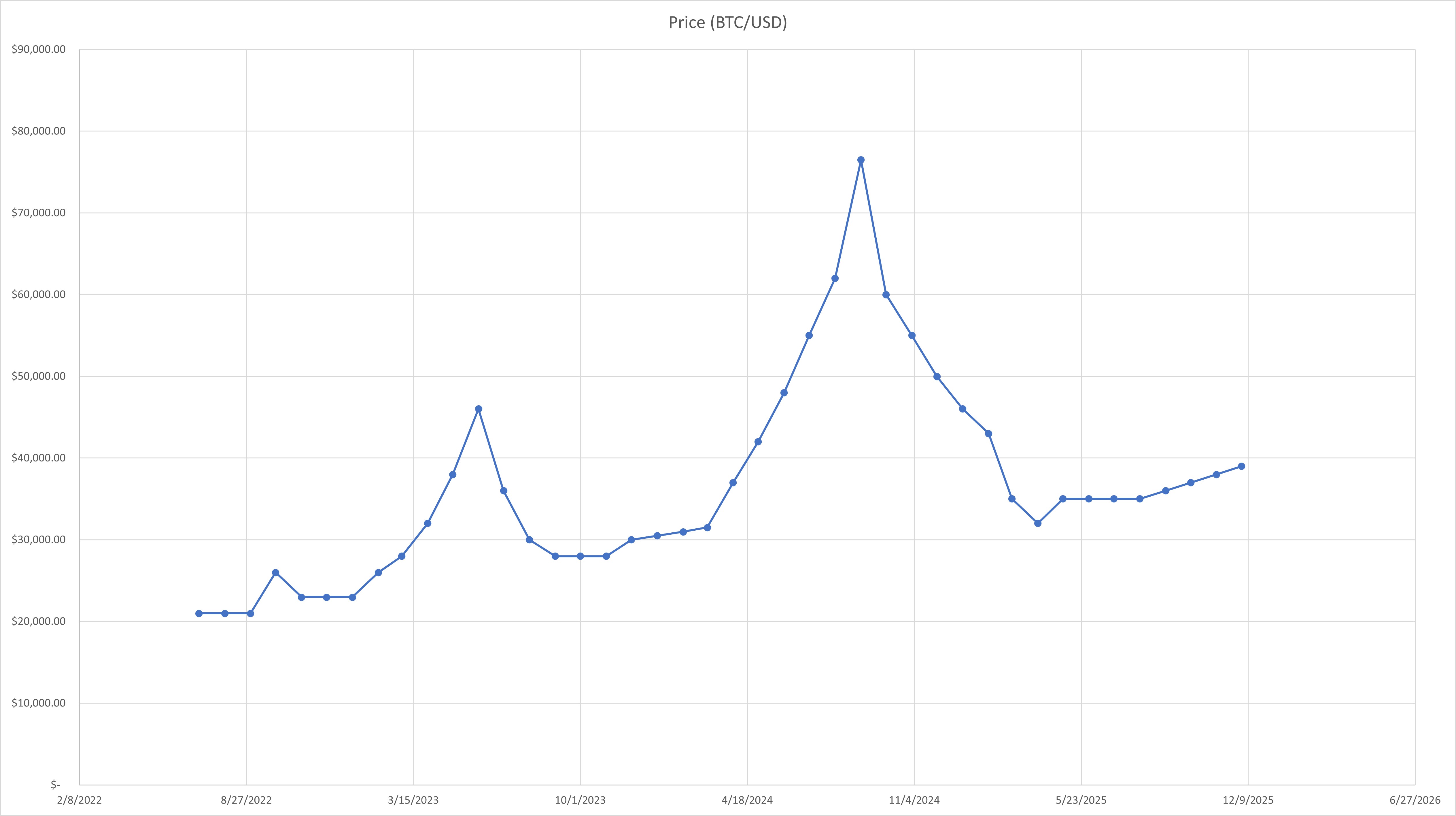
First, the current crisis in lending will significantly impair the market in the short term. So much money was destroyed that investment in the industry will be slowed. There will be a fall in transactions and usage as people whose lives were ruined simply have no money left to spend and trade. Expect six months before any significant movement, except perhaps a brief surge in all coins a month before the Ethereum merge, if it actually occurs in October as the prediction markets suggest.
Second, the litecoin block halving, unfounded hype about Ethereum's sharding about its currently projected release date in 2023 (which will be delayed again,) cash "early payouts" from the Mt Gox. bankruptcy settlement, and the release of some depositor money from one or more of the frozen platforms will pull up bitcoin's price a year from now. This is the last litecoin block halving that will be relevant to pricing.
Third, by this point, cryptocurrencies are already far along their adoption curve. There will be limited or no uptake of actual spending of cryptocurrencies by humans in commerce from now on; the use case by humans seems destined to remain as money remittances and value storage. Therefore, the price of bitcoins won't reach $100,000 until 2028 or 2030, and the price won't exceed $150,000 until the singularity approaches, which may be ten or forty years from now. Despite that, cryptocurrencies - particularly bitcoin - will still beat the stock market over the next four years. After that, I think that AI, metaverse, and anti-aging stocks will far outperform cryptocurrencies.
Fourth, the bitcoin block halvings, which are one cycle ahead of the litecoin halvings, now decrease mining supply by such a small amount that they are already irrelevant and will have minimal impact going forward. Even in the past, people tried to ascribe four-year cycles to cryptocurrency prices when there clearly have been three instance where there were all-time highs after 50% drops in the same 4-year period. The time periods for bubbles don't line up with the halvings. There were also other more significant events associated with the existing bubbles, like the Mt. Gox "Willy bot" for the second 2013 bubble and the ETF speculation for the second 2021 bubble.
Fifth, there has been no evidence that volatility on the long term charts is declining to any significant degree. Therefore, expect to be able to buy bitcoins for under $35,000 during the crashes for a while to come.
Sixth, the coming recession will cause the Fed to again lower interest rates in 2024, which will result in the next bubble that peaks two years from now. I would suggest this next all-time high is around $75,000. Perhaps a few years after that, we get another bubble in the $80,000s.
Seventh, Ethereum will outperform bitcoin in the long run, and will become #1 during the second bubble on this chart if sharding is actually released in 2024. If sharding isn't released, Ethereum will still outperform but not flip. However, the market is failing to recognize that proof of stake has a much higher probability than currently predicted of causing the failure of the Ethereum network due to security issues. While that risk is low enough that I didn't include it in this chart, that outcome would be devastating for all coins.
Eighth, there will be no bitcoin spot ETFs approved while a Democratic administration is in office. Not only that, the Greyscale lawsuit against the SEC will go all the way to trial, the SEC will not settle, and Digital Currency Group will lose. If DeSantis wins, he will appoint regulators that will allow business free rein, and his SEC chairman has a low chance of approving an ETF. If Trump, who outright tweeted his disdain for bitcoin, or a Democrat wins, there still won't be any ETFs.
Ninth, coins that people dismiss as "jokes" will continue to shock people. Dogecoin, for example, has much more transaction capacity than the bitcoin network and has been obliterated in this recent crash. What's more likely - dogecoins being worth 24 cents (33% of their all-time high), or bitcoins being worth a new record of $80,000?
Tenth, a major reason why upside is now limited is because of poor regulations. The SEC's catastrophic handling of lenders was partially responsible for their failure, and the SEC's ETF restrictions will restrict stockholders. Europe's stated desire to impose paperwork on cold wallet users makes cryptocurrency less desirable. The latest news that US officials who hold cryptocurrencies are prohibited from writing policies governing their usage takes the cake for dumbest idea, as now the only people who can enforce the law are those who know nothing about what they are regulating.
Themes of this cycle
In previous cycles, there were "themes" that seemed to drive the narrative. In 2017, there were many ICOs, in 2021 NFTs flooded the marketplace, and in 2022, lending was the story. Look out for what the next big thing is. People are arguing that the metaverse is very close to widespread adoption, and that the next narrative will involve it. However, the only company that seems to care about the metaverse right now is Meta spending its $10b per year, with Apple, who could dominate the field if they wanted to, foolishly passing. As a result, I believe the metaverse will, unlike the Internet, be centralized in Meta, and I can't yet see how blockchains can do anything for the centralized metaverse that centralized databases can't.
A more likely narrative might involve blockchains that represent fungible things of value other than money, like how Filecoin represents disk space. Getting back to the three areas I think are the highest growth in the next ten years (AI, metaverse, and cures for aging), I wonder if fungible tokens might emerge that represent AI computation time. AIs are difficult to train (and to a lesser extent, run) with the limited power of a standard PC, but perhaps there could emerge a distributed AI where tokens can be spent to do tasks, like where you can spend one coin to generate a video game map. A person (or another AI) spends the tokens, the computers do the task, and deliverables are returned to the purchaser. The price of these tokens would decline exponentially over time as more computing power and better software becomes available, and business owners would slowly replace human employees when the token cost for that AI task falls lower than the salary the human who can do the same task is willing to accept.
Conclusion
In conclusion, the trend has reversed, and we are in a bull market. Although further information about insolvencies may emerge, it will be old news and the damage already occurred during the week of June 13. However, the field has been significantly damaged by the insolvencies of the retail lenders, and those insolvencies will slow and cap the progress in the next cycle.
The two major lessons from the previous cycle are that the cryptocurrency markets are not seeing a major change in patterns or a reduction in volatility over time; and that cryptocurrency is now far enough along in the adoption cycle that there is a good deal of confidence that humans will never use bitcoins for everyday transactions. The pricing pattern has not become and will not be different, and there does not appear to be any trend towards a steady curve of user adoption.
There is definitely money to be made, but it's time to reexamine the thesis that bitcoin will become a world currency and lower expectations for future price gains.
Comments (0)
Archived discussion. New comments and replies are closed.
No archived comments on this article.