
Ethics, Honesty, and Integrity
HOW PROHASHING DOES BUSINESS
Since PROHASHING was founded on Monday, December 23, 2013, the company has made honesty, transparency, and regulatory compliance its top priorities. Every decision made at PROHASHING is made with these three principles in mind.
This overview covers how PROHASHING follows strict guidelines to ensure that its customers, business partners, and employees are reputable, honest, and legally compliant. From a "source of funds" perspective, it is impossible for a mining pool to receive money from criminals. In fact, as you'll read below, when the inherent safety of mining is combined with the additional steps that PROHASHING takes to comply with US Internal Revenue Service (IRS) regulations, PROHASHING is safer to do business with than a toy store, as the toy store has no way to prevent itself from unintentionally doing business with undesirable people.
SOURCE OF FUNDS
"Source of Funds" is a legal term that refers to the chain of custody of money that has been received by an individual or business. Banks, for example, will often request documentation that proves how money deposited into accounts at branches was obtained. People who receive such requests can satisfy them by, for example, providing a copy of a paycheck or a deed from the sale of a house. Drug dealers, meanwhile, are usually unable to provide proof of where their money originated, and banks can close the accounts of people who fail to provide proof.
Let's review three examples that illustrate why mining pools like PROHASHING are the only type of company in the entire world where suppliers can be 100% certain that there is no illegal activity anywhere in the history of the money being paid to them. First, we'll review the money flow through a typical bank, then through a toy store, and then through a mining pool.
Banks
Banks are usually registered as "money services businesses," as they receive money from one person and transmit it to a different person or location. A typical workflow for money moving through a bank is shown in the diagram below:
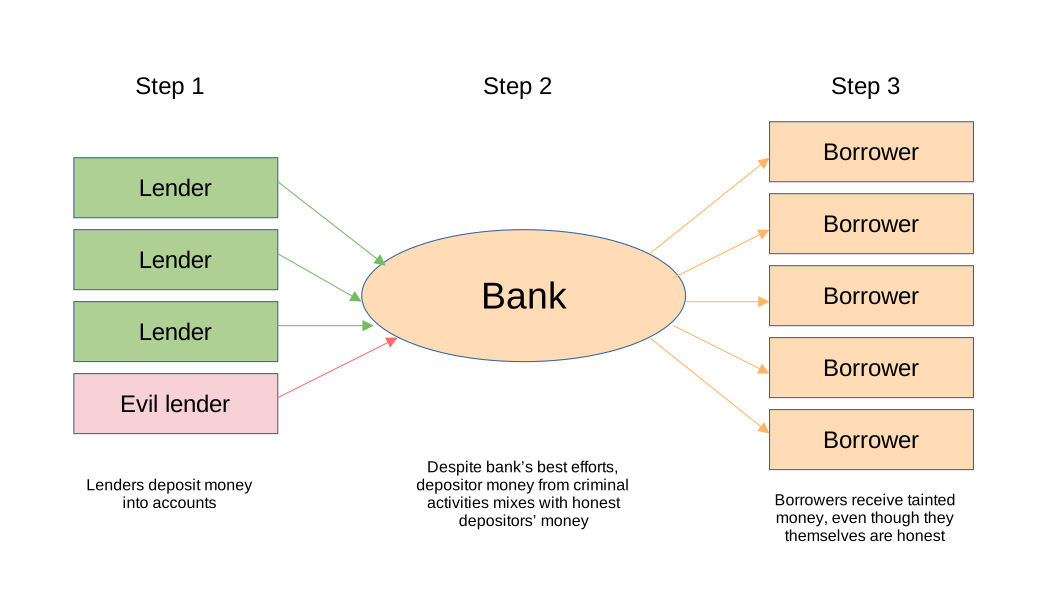
In step 1, the bank receives deposits from customers who lend it money. In step 2, the deposited money is aggregated in a safe, an account at a larger bank, or an account with the Federal Reserve. In step 3, this mixed pool of money is then lent to borrowers, who want to buy things like cars and homes.
If any of the money was received from a depositor involved in criminal activity, then the bank's deposits are tainted, and borrowers doing business with the bank can't be sure that the loans they received are entirely legitimate. In fact, most of the the largest banks, which claim to follow the strictest regulations, have been implicated in profiting from moving staggering sums of criminals' money. For example, JP Morgan assisted in the defrauding of the Malaysian government for over $1b, even after being fined for similar offenses.
Even if one assumes that a particular bank is 100% honest about intending to follow the law and only makes a mistake in identity verification 0.01% of the time, the law of large numbers implies that the bank will still unintentionally service at least one criminal after just 10,000 accounts have been opened.
Toy stores
Initially, it might seem that a toy store is a type of business that is much less likely to receive money from criminals. In reality, such a store presents a much larger risk than a bank does, as the following diagram indicates:
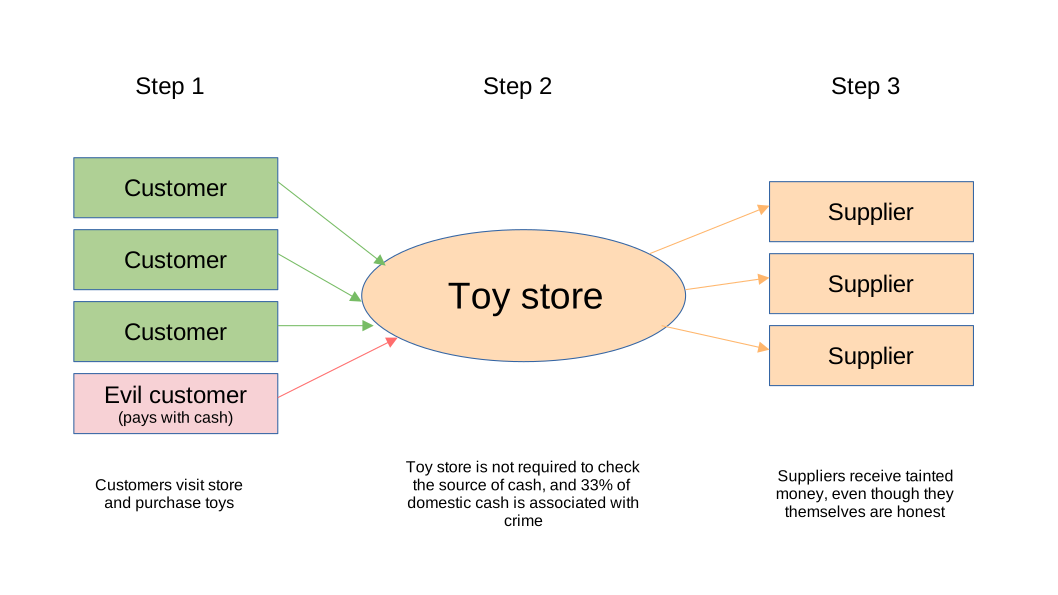
In step 1, the toy store sells toys to its customers, and receives cash and bank deposits from credit card processors into its accounts in step 2. The revenue is then used to pay its suppliers and other service providers, like e-commerce platform hosts in step 3.
Toy stores are not required to perform identity verification on their customers, and usually accept cash, which has exchanged hands many times since it was initially created by the Federal Reserve. Even with the best intentions, the toy store cannot, and is not required to, verify that the cash was generated from a legitimate source. In fact, about one-third of all cash in the United States is estimated to originate from illegal activities, like drug dealing and tax evasion. Even people paying cash to the toy store may not know that their employers generated the cash through illegal activity.
As a result, suppliers of the toy store are likely to be receiving drug money, stolen money, and unpaid tax money without knowing about it.
Mining pools
Cryptocurrency mining is a unique business, in that it is the only commercial activity in the entire world that creates money with no history. The following diagram presents the typical money flow of a mining pool:
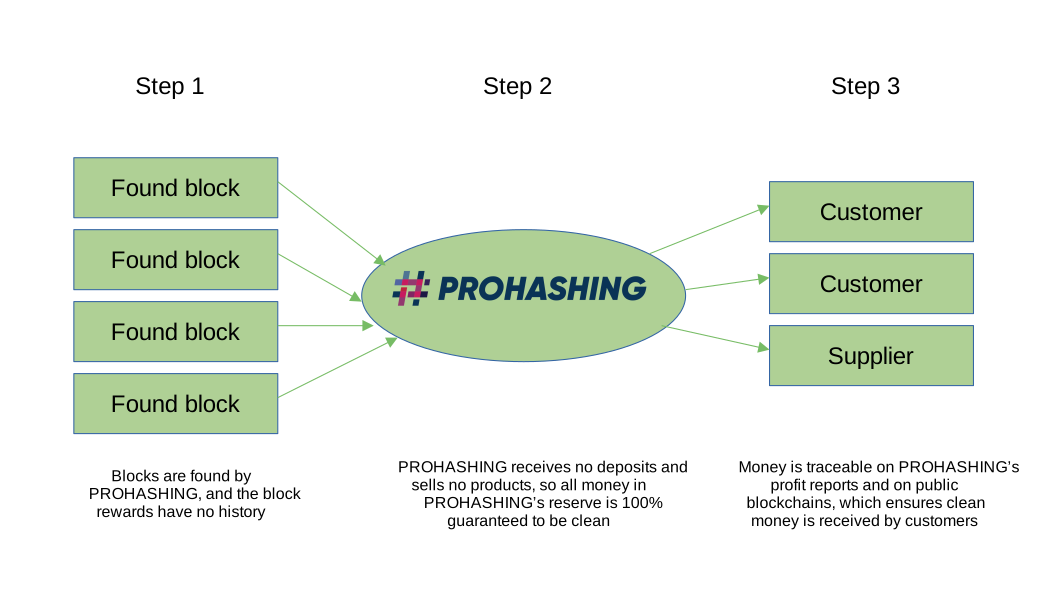
In step 1, the mining pool creates money by mining blocks. The blocks are confirmed by the network, and deposited into the pool's reserve in step 2. In step 3, these coins are paid to service providers.
Coins created by mining have no history; in the coinbase transaction recorded in the blockchain, the input is literally recorded as 32 bytes of zeroes. Unlike all other types of businesses, it is mathematically impossible for a mining pool to have received money through illegal activity. Furthermore, the revenue earned through mining has no history whatsoever, so there is zero possibility even of unknowingly receiving money from unwitting accomplices who themselves were paid with criminal profits. Unlike the previous two examples, every step in the diagram for a mining pool can be viewed publicly by vendors so that there is no requirement of trust.
Other than receiving money directly from the Federal Reserve or another central bank, which is restricted to a small number of large financial institutions, mining is the only source of truly clean money in the entire world. For that reason, although PROHASHING does not service the new blocks market, money generated by reputable mining pools can be exchanged higher than the "spot" rate to entities like investment funds that want to eliminate their risk of receiving stolen money.
HOW PROHASHING EXCEEDS EVEN TYPICAL MINING POOLS
As the previous examples demonstrate, mining pools are, from a money laundering perspective, inherently the safest type of company to do business with. However, PROHASHING goes above and beyond simply mining, by eliminating any possibility of funds mixing, by minimizing the number of business partners, by complying with all regulations, and even by verifying the identity of some customers who PROHASHING is not legally required to verify. Here are some of the ways that PROHASHING goes above and beyond:
PROHASHING sells no products.
To be 100% certain of the provenance of all of its funds, PROHASHING intentionally sells no products and provides no services other than mining. For example, ads are not posted on any of PROHASHING's websites, so no money is received from advertisers. PROHASHING even decided against making a profit off of t-shirts and coffee mugs with its new brand identity, so that the company cannot be accused of having received small amounts of money from people who purchase the trinkets. Instead, if customers want to purchase these branded items, they do so directly from a 3rd party, at cost. PROHASHING receives no money from said transactions.
PROHASHING's only revenue-generating business activity is mining. It receives no money from anyone.
PROHASHING minimizes its number of vendors.
PROHASHING intentionally restricts the number of vendors with whom it does business. Currently, the only external companies providing services to PROHASHING are Digital Silk, a well-known international advertising agency, Comcast, a telecommunications provider, Cloudflare, a global cloud platform, Microsoft, for its Office suite, Leech Tishman, which is auditing PROHASHING's taxes to proactively detect errors, exchanges like Bittrex to sell PROHASHING's mined blocks, Authenteq, an FNZ company, which provides eKYC™ services for members of the PROHASHING Trusted Mining Program, and Atlassian for its development tools.
To reduce associations with other providers, PROHASHING develops as many tools as possible in-house. For example, PROHASHING wrote its own E-Mail marketing software to reduce the number of business associates. PROHASHING also conducts periodic assessments to eliminate associations that are unnecessary, such as when it cancelled Jira Service Desk for support in favor of Chatwoot, an open-source alternative. The company uses open-source software over commercial software wherever possible, such as having installed Jitsi Meet on its own servers rather than purchasing a videoconferencing contract from Zoom Communications.
PROHASHING has terminated business with companies that fail to comply with IRS regulations. For example, PROHASHING stopped paying for advertising at a cryptocurrency site because the site refused to reply to a request to complete a W8-BEN form.
PROHASHING secures its money.
Large cryptocurrency thefts in the past have almost always been accomplished through two means: deceit of employees, or because money was stored in "hot" wallets accessible to the Internet.
PROHASHING stores 98% of its own reserve and money owed to customers in cold storage. Cold storage is secured using three copies of seed words and a password, as described in the Wallet Security guide. As the guide directs, the cold storage passwords and keys are stored in banks and are buried in unmarked areas of public forests. Because access to one of the bank vaults and also knowledge of the location of one of the burial sites are both necessary to spend any money, no external organization or government can access the funds in cold storage. Even if someone were to gain access to one half of the data necessary to spend the funds, such as through a search warrant or by an unbelievably lucky search digging up entire forests, that person would still need the other half to steal any money.
The only people with the knowledge of the bank vault and burial site locations are PROHASHING's two owners. The cold storage keys were rolled out with dice and written down with a pen on paper, to eliminate any possibility of software error or connectivity with the Internet.
PROHASHING is not an exchange.
As described in PROHASHING's terms of service, PROHASHING is not an exchange, bank, or financial advisor, and does not provide legal advice.
The company does not accept deposits. PROHASHING goes even further than the law requires by prohibiting customers from requesting a different payout method once mining has already occurred; if a customer requested originally to be paid in bitcoins for his rented mining power, a request for litecoins instead will not be honored. PROHASHING interacts with the legacy financial system only through Kraken and Coinbase, money services businesses with SOC 2 Type 2 certification, and with a registered MSB provider of ACH payout services.
PROHASHING issues payouts as often as coin networks allow to reduce money in its possession. On networks with free transactions, the full balances are sent daily. On more expensive networks, payouts are sent when the balance reaches 200 times the network transaction fee. Customers are not permitted to override these restrictions to retain large balances with PROHASHING.
PROHASHING does not provide financial advice, and does not offer assistance to customers who ask which coins to buy or sell.
Finally, PROHASHING does not offer legal advice about taxation, and customers requesting such advice are directed to contact an attorney of their own choice.
PROHASHING prohibits discussion of illegal activity.
PROHASHING operates forums and participates in discussions on social media sites like Facebook and Twitter. As PROHASHING's forum rules state, discussion of illegal activity of any kind are prohibited. The prohibition not only covers illegal activity facilitated by the forums, but also bans legal activity like talk about darknet markets, even if the topic is only about news coverage of the market. A rule specifically prohibits any discussion of illegal drugs in any context.
When responding to posts on twitter, Facebook, and other social media, PROHASHING's public relations team reports to the social media provider all mentions of illegal activities from commentators in replies to PROHASHING's posts, and ignores or hides them if the reports are ignored.
PROHASHING's Ransomware Policy bans customers from using PROHASHING for any activities associated with ransomware, such as paying ransoms. While PROHASHING creates fully disconnected backups to protect against ransomware, the policy further clarifies that PROHASHING will never pay a ransom under any circumstances if it were to become a victim of ransomware, even if failure to pay would result in PROHASHING's closure.
PROHASHING identity verifies most of its largest customers.
The PROHASHING Trusted Mining Program provides bonus revenue to customers who verify their identities with using a driver's license or passport. In addition to verifying identity, Authenteq, an FNZ company, also performs "adverse information" searches to discover criminal records and negative financial histories.
Additionally, while PROHASHING does not perform identity verification for form 1099-NEC submissions, 100% of customers who earn more than $600 per year are known to PROHASHING by name and address.
PROHASHING publicly posts daily profit reports.
As a private company, PROHASHING is not required to disclose financial statements, but PROHASHING nevertheless posts daily profit reports. These reports allow anyone, including potential business partners, to see exactly how many blocks of each coin have been earned. The information can be correlated with the public blockchains on any block explorer to verify its authenticity. Businesses can then see how PROHASHING's revenue always exceeds the amount paid to its suppliers, eliminating the possibility of any untraced funds.
PROHASHING does not serve children under the age of 13.
Whereas many companies sell products or provide services to children, PROHASHING does not permit anyone under the age of 13 to create accounts or to mine with the company. PROHASHING's avoidance of services to children reduces the risk of noncompliance with laws that require additional safeguards when dealing with children.
PROHASHING does not provide data to third-parties.
PROHASHING's Privacy Policy states that the company does not provide customer data to third parties for any reason, even for common tasks like E-Mail marketing. PROHASHING does not engage in "remarketing" activities and does not share information in its database with anyone. PROHASHING only provides data to government agencies when requested by a court, or to assist in a police investigation.
PROHASHING stores sensitive data offline.
When identity information is submitted to PROHASHING, the servers immediately encrypt it with a public key. The private key to decrypt this data has never been stored on any computer connected to the internet, at any time, ever. To further secure this sensitive data, it is moved offline to disconnected disks within 6 hours after upload.
PROHASHING has an independent auditing system.
PROHASHING retains records of every block mined and every payout issued since the pool was founded on Monday, December 23, 2013. These records are stored in a massive 20TB database that exists independently of the public blockchains. PROHASHING conducts periodic audits to identify balance discrepancies; these audits have in the past identified cases where companies were defrauding PROHASHING.
PROHASHING also maintains a monitoring system that checks for 426 error conditions, which proactively warns the company, even during the overnight hours, of issues with its own and other companies' systems.
PROHASHING complies with all IRS regulations.
PROHASHING invests significant time and money to ensure compliance with all laws and regulations, with particular attention to those required by the Internal Revenue Service. Compliance with these laws costs PROHASHING 2% of its revenue, which is why the company is unable to compete on price against noncompliant pools like Nicehash and litecoinpool. In fact, when PROHASHING strengthened its compliance measures on Monday, January 1, 2018, over two-thirds of its customers left the service and $1m in estimated profit was foregone, but PROHASHING continued to operate legally despite knowing these losses would occur.
IRS regulations (see document, answer A-13) state that PROHASHING is required to mail forms 1099-NEC to all US customers earning more than $600 in a calendar year, so PROHASHING does so. In 2019, for example, 1,350 forms were mailed. PROHASHING continually improves its error-detection process to ensure submitted data is accurate; for example, the company checks TINs with the IRS APIs and addresses with United States Postal Service APIs. Payouts are frozen for customers who the IRS has identified as having provided invalid data.
PROHASHING also collects forms W8-BEN and W8-BEN-E from non-US customers, and pays an employee to review these forms for errors. Payouts are withheld from customers who make errors until they have resolved them.
PROHASHING retains Leech Tishman LLP to advise the company on IRS regulations. While PROHASHING has never been audited by the IRS, Leech Tishman is conducting a proactive audit of PROHASHING's tax returns to ensure that PROHASHING complies with all regulations and to ensure that the company has not missed anything in its filings.
PROHASHING's employees are trustworthy
PROHASHING's employees are its most important assets, and PROHASHING ensures that its employees meet the highest standards of conduct. PROHASHING's employee contracts state that any use of illegal drugs, whether in the past, present, or future, is grounds for immediate and unconditional termination. Use of drugs permitted at the state level but which violate Federal law, such as marijuana, are still prohibited. Names and pictures of PROHASHING's team are available at the bottom of the "About Us" page.
We are willing to provide criminal background checks as evidence of our trustworthiness to select vendors.
PROHASHING provides honest, efficient support every day
PROHASHING provides customer support through a variety of platforms. Anyone can contact a PROHASHING employee through our official support channels and troubleshoot issues or discuss business problems with the expectation of a reasonably quick response. PROHASHING provides five methods to contact the company, from authenticated messages through its website, to twitter direct messages, to phone calls. When contact is initiated, someone will respond within 24 hours.
Because the world doesn't stop on weekends, and because urgent issues often need attention quickly, PROHASHING offers customer support every day, including weekends and holidays.
PROHASHING has never lost any money to hacking
PROHASHING takes security seriously. Every part of the system that deals with money uses a three-step process. For example, when payouts are executed, the system performs three checks: it confirms there is enough money in the wallets, it confirms that the audit database matches the money owed in the wallets, and it halts payouts when any of a number of general warning conditions are present, such as when the amount earned by miners has increased by more than 30% from the previous day.
At the individual account level, every payout address change generates an E-Mail to the customer notifying him or her that the address was changed, so that if an individual account were compromised, action could be immediately taken.
CONCLUSION
There is nothing inherently unethical about cryptocurrency. Unfortunately, dishonest people are often the first to take advantage of new technologies, such as how "phone phreaking" was one of the first widespread uses of networked computers in the 1950s. Dishonest people who run money-laundering exchanges and tax-evading mining pools have soured the first impressions of the public, even though older technologies like banks and cash are more widely used to commit financial crimes.
PROHASHING is different from those businesses. PROHASHING complies with all IRS laws and regulations, but also takes further steps to prioritize security and transparency. PROHASHING has never lost money in cyberattacks, and has strict policies against ransomware, drug use, and discussion of illegal activity. PROHASHING conducts independent audits, monitors its systems, requires multiple checks before money is spent, and publishes public profit reports to account for every coin mined. Unlike private banks, public blockchains allow business partners to track the mined blocks and movements of PROHASHING's funds. PROHASHING does not operate an exchange, and only interacts with the legacy financial system through a SOC 2 Type 2 certified US-located money services business. PROHASHING sells no products and provides no services other than mining so that none of PROHASHING's mined blocks are mixed with money of an unknown source.
Mining pools are the only business in the world that creates money with a 100% known provenance, so vendors and partners can be assured of the source of all funds paid by PROHASHING.
Comments (0)
Archived discussion. New comments and replies are closed.
No archived comments on this article.