
Exposing the lenders
I've noticed recently how, on social media platforms, the level of outrage over what the crypto lenders did seems to be disproportionately low compared to the immense and life-altering harm caused to their victims. Few users seem to understand the blatant nature of the fraud that the lending business was built upon, and those who do seem too afraid to share what they know with the public.
It's time to change that. In this series of posts, I will release documents and information that demonstrate that CEOs, upper management, and even many normal employees were aware that the platforms were defrauding their customers. Many of these people were either actively involved in the frauds or were aware of its existence and chose not to resign. They lied, misled their customers, omitted key information in sales pitches, and provided false documents to their clients.
I will show that Sam Bankman-Fried did not cause crypto lending companies to fail. They failed because their own officers made irresponsible, and often fraudulent, decisions, and because they lacked the basic human decency to understand that they were entrusted with the efforts of thousands of years of labor. They then made false or misleading statements to depositors to cover up what was actually occurring behind the scenes. The entire industry was based on lies and deceit. Every single employee who can be shown to know what had been going on at these companies needs to pay - literally - with their personal assets, and every company that knowingly did business with these firms should be driven into bankruptcy.
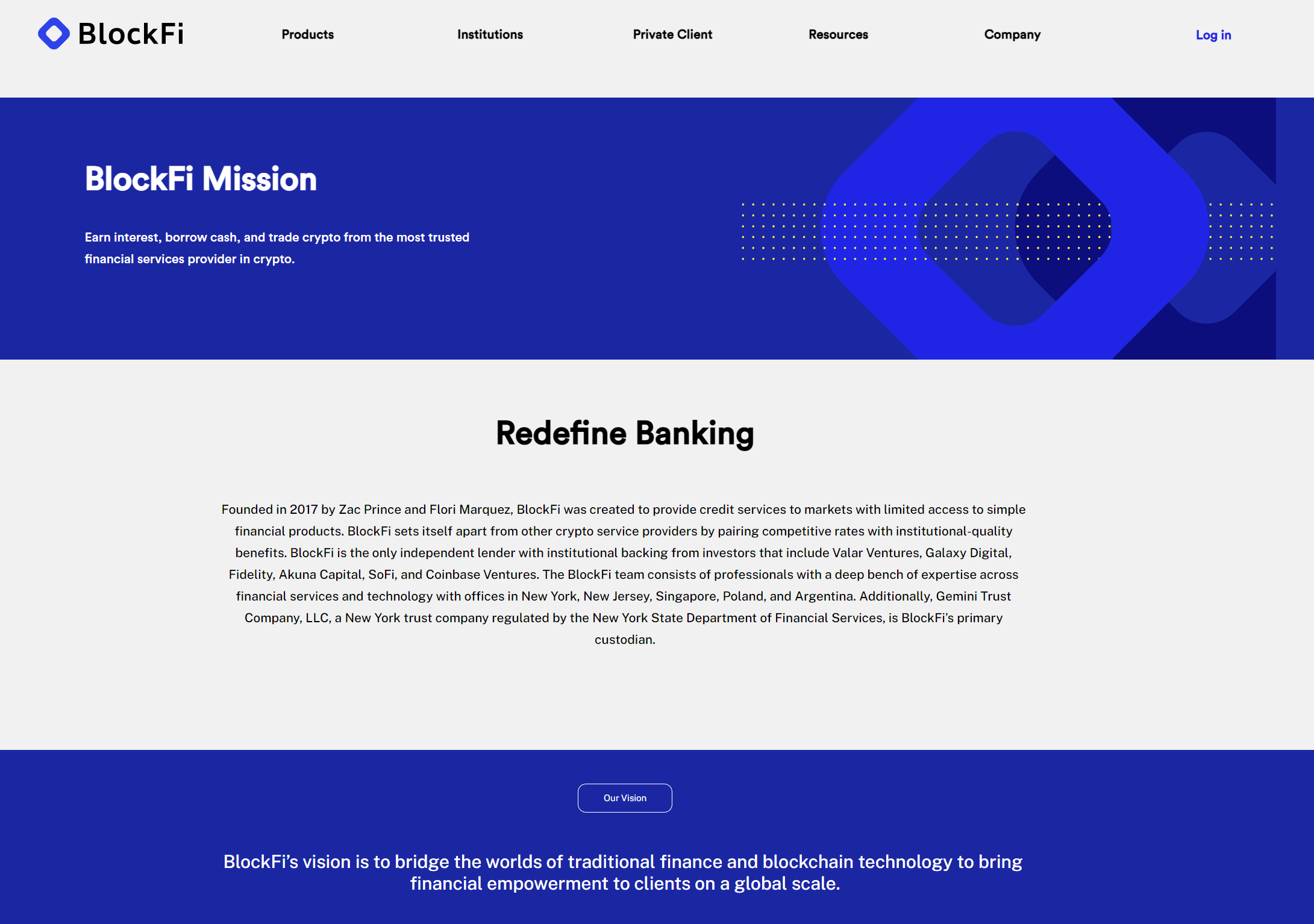
Today, we'll focus on BlockFi.
Key takeaway
Because I knew that it was extremely important to choose a trustworthy lender due to the amount of money at stake, in September 2022, I took a break from PROHASHING and spent 150 hours of labor performing intense research on almost all lenders in the crypto lending industry. This research led to the discovery of some key evidence that deterred me from depositing at firms other than BlockFi and Genesis. For example, I became worried about how many company tokens were on Nexo's books, and I decided against offering deposits to Ledn because co-founder Mauricio Di Bartolomeo failed to provide the company's balance sheet to me.
We had three options during this period: to work primarily with Genesis (if Genesis was solvent but no other company could be shown to be trustworthy,) to split deposits between Genesis and additional firms for diversification (our preferred option,) or to stop depositing with the crypto lending industry in its entirety (if no firm had solid documentation.)
During this research, I requested loan books and accounting data from BlockFi, Genesis, and the other companies. I used statistical analysis to compute probabilities of failure based upon prices, ratios of bad debt, and business activites. By September 30, we made the decision that BlockFi and Genesis were the only trustworthy lenders in the industry, and split the money approximately between them. The sole and only reason that we decided to deposit and to renew our deposits was because I was provided with false or misleading statements and documentation by these two companies, their employees, and their officers and directors.
It is not true, as is being reported in many media outlets, that depositing at these two companies was "very risky." The information I analyzed through weeks of research showed that there was low risk. Had that information been truthful, it is unlikely that either company would have failed.
Background
PROHASHING deposited coins at BlockFi through Cryptocurrency Management, a limited liability company registered in Pennsylvania. The company was formed solely to aggregate assets from PROHASHING, me, PROHASHING CEO Christopher Sokolowski, and two others to obtain competitive rates from lending firms. The assets from PROHASHING were a combination of some of the pool's "reserve" and some money expired by PROHASHING's "end of liability" policy - debts owed to anonymous customers who had failed to submit their names and addresses for tax forms at least five years ago and who therefore were still unable to be located.
Cryptocurrency Management solely lent money to Genesis between its founding in May 2021 until September 26, 2022. The Genesis loans were open-term until June 2022, when Genesis changed its rate structures to offer significantly higher rates for fixed-term loans, which caused Cryptocurrency Management to sign three-month contracts. On September 1, Cryptocurrency Management signed an open-term contract with BlockFi for 140 ETH that might be needed for short-term expenses. As Cryptocurrency Management diversified, more money was deposited with the lending firms. Cryptocurrency Management was the first "private client" to sign an open-term contract with BlockFi; the product was so new that BlockFi's engineers were still fixing bugs on their website for it.
Later in September, BlockFi contacted me in regards to loans from Genesis, as our three-month terms at Genesis were about to expire. BlockFi wanted some or all of the money to be transferred to them from Genesis. At that time, Jonathan Espinoza was laid off or resigned from BlockFi, and the sales pitch was handed over to Erin Self, who herself was new to the "private client" sales team. No evidence has been found to either implicate or exonerate Jonathan, Erin, BlockFi Private Client Manager John Malarney, or BlockFi accountant Michelle Henry in BlockFi's activites.
With the exception of the discussion with CEO Zac Prince, which occurred in a video call, all of the discussion is available in written evidence that is linked at the end of this post.
The sales pitch
On the morning of September 21, Erin set up an audio-only call with Private Client Manager John Malarney, herself, and me. During this call, Malarney was kind but was unable to provide much detail about BlockFi's lending practices. I was surprised that the manager of the Private Client department would be so unclear about BlockFi's loan book, as it seemed to me that BlockFi's financials would be important to potential lenders. My impression was that information about the loanbook was closely held by upper management.
I then asked to review BlockFi's balance sheet. BlockFi went through an approval process and provided the balance sheet. The document showed that BlockFi had an excellent ratio of member's equity to loans outstanding. The sheet appeared to show that the company was in a better financial situation than Genesis, which led to the decision to continue to diversify the loans away from Genesis and to increase the value of deposits at BlockFi.
The balance sheet did not mention anything about FTX custody or FTX's FTT tokens. In fact, the balance sheet made no mention of FTX whatsoever. Statements at the time, and later in November, indicated that BlockFi was an independent company from FTX and would remain so for some time.
False or misleading statements about FTX
In the E-Mail chain that is listed in evidence, I wrote that I would consider lending half the bitcoins that were currently lent to Genesis, but asked whether BlockFi had ever used its credit line with FTX. Erin stated that the facility was solely to provide "long term stability for the company." She falsely or misleadingly wrote that no outstanding debt was owed on the FTX credit facility:
"The credit facility is intended to be structured as junior to all client balances across all account types (such as BlockFi Interest Account, BlockFi Personalized Yield and BlockFi loan collateral) at BlockFi. We have drawn on this but paid it back since it's a revolving credit facility."
However, on page 17 of the BlockFi bankruptcy filing, BlockFi acknowledges that the company actually had $250m outstanding against its line of credit with FTX. The FTX bankruptcy filing also states that BlockFi had this amount borrowed as of September 30. It is unlikely that an emergency suddenly occurred to require the use of this credit facility between September 24 and 29, and even if one had occurred, that nobody at the entire company knew that the loan was in preparations to be tapped.
It was later reported that BlockFi may have been storing customer assets in FTX's custody, in contradiction to statements on BlockFi's website stating that Gemini Trust company was BlockFi's "primary custodian." Despite the multiple E-Mails regarding reservations about FTX, and direct questions to Prince about his involvement with FTX, no mention was made of a past or impending change to FTX custody. Obviously, if customer money was in FTX custody, then even the full credit line would have been insufficient to protect BlockFi in the case of FTX's failure. And, if customer money were in FTX custody, then the statements by Prince and BlockFi co-founder Flori Marquez that FTX was an independent entity from BlockFi were false.
Refusal of loans due to association with FTX
On Friday, September 23, I made the decision to reject BlockFi's offer and to keep the money in question lent to Genesis, because BlockFi appeared to be too dependent on FTX. In the E-Mail chain, I wrote the following as the reason for rejecting the deal:
"Your balance sheets look good, but because the FTX deal closes during the fixed loan's term, we believe the uncertainty introduced by that deal is more risk than the spread between your and Genesis's long-term rates."
I then sent a Telegram message to Griffin Tiedy at Genesis, asking him for a fixed-term contract for the bitcoins that would otherwise have been sent to BlockFi. After I received the Genesis contract, I downloaded it, read it, and prepared to sign it. With about two minutes to go before I was to sign the contract, Erin replied with the following invitation:
"Happy Friday! Would you be interested in having a call with Zac Prince to further talk through the FTX deal and any other questions you may have? I'd love to set that up. Please let me know and I can find a time that works for both of us."
Hearing that Prince wanted to talk to us, I postponed signing the contract with Tiedy pending the meeting with Prince, which was to take place at 11:30am that morning.
Meeting with Zac Prince
The meeting was attended by Prince, Erin, BlockFi accountant Michelle Henry, me, and two additional Cryptocurrency Management depositors. Erin arrived five minutes early, along with me and the second depositor. Erin had just returned from a vacation. During the waiting period, the three of us talked about that vacation that Erin had taken and about her experiences during the trip. The third depositor and Henry arrived at around 11:30, and Prince arrived last at 11:31. I asked most of the questions during the meeting, and Prince answered most of the questions. The second depositor and Henry spoke almost not at all.
The first topic of conversation was regarding the number of employees BlockFi had. I questioned Prince why BlockFi needed 800 employees and whether there were any plans for additional layoffs, as I was concerned about BlockFi's financial outlook being harmed by high labor costs. Prince responded that BlockFi had previously employed 1000 people and that it was continuing to reduce headcount through buyouts and attrition. Prince then segued into BlockFi's profitability. He acknowledged that BlockFi had been thrust back into unprofitability with the 3 Arrows collapse, but that conditions were improving, and that the trend was towards becoming profitable again soon.
Prince mentioned that a big part of achieving profitability was getting the SEC to approve their registration to offer BlockFi Interest Accounts to US customers. The accounts were, at the time, limited to international customers only. BlockFi had paid a fine to the SEC to settle a case earlier in the year and Prince believed that because of the settlement the SEC would be more willing to work with BlockFi to allow them to provide this service to US customers than it would to its competitors. I asked Prince why he believed that SEC Chair Gary Gensler would want to grant approval to any company at all. Prince said that he wasn't able to go into detail about the status of the SEC's deliberations but that he believed BlockFi would receive approval.
The conversation turned to FTX. Previous E-Mails with Erin had indicated that the loan from FTX to BlockFi had been fully repaid. I asked Prince about the relationship BlockFi had with FTX. Prince stressed that BlockFi and FTX were independent entities, and falsely or misleadingly stated that the FTX line of credit was not being used. Bankruptcy documents show that the credit line had been, in fact, drawn upon as of September 30. All three Cryptocurrency Management depositors left the meeting with the impression that the FTX credit line was not, and had never been, necessary for BlockFi's operations, and had been drawn but repaid after the June collapses ended.
Prince then turned the conversation to the bankruptcy of 3 Arrows. Prince bragged that BlockFi had lost less money than Genesis had in the 3 Arrows bankruptcy. I mentioned the lending practices of other lenders, like Ledn. Prince said he knew the COO of Ledn, Mauricio Di Barthalemo, and asked how Mauricio was doing. I replied that Mauricio had attempted to sell me on depositing to Ledn on September 20. I said that Ledn had claimed they were lending to Alameda Research, an FTX-owned subsidiary that practiced "market-neutral trading strategies." John Glover, the chief of risk management at Ledn, had attended that Ledn call and bragged that Ledn offered lower rates than BlockFi because companies like Alameda Research were more trustworthy than the counterparties to which Genesis and BlockFi were lending. Prince remained silent on the matter and didn't comment. It was reported in November 2022 that Alameda Research had abandoned market-neutral strategies over two years earlier.
I asked Prince if BlockFi gave loans to miners, many of which were in distress. Prince confirmed that BlockFi did indeed have bad debt from miners on their books. Prince said that the debt was limited to about $250m, and that BlockFi had already written down some of the bad miner debt to zero, so that the statements would not have included that debt in their current assets. No evidence has been found to prove or disprove the truthfulness of Prince's statement about the $250m in miner debt, but this information may be present in the BlockFi bankruptcy filing. BlockFi is one of bankrupt miner Core Scientific's largest creditors.
The conversation turned to yields and interest rates. I asked Prince why the yield curve at BlockFi was such that longer-term loans were yielding higher rates. Genesis's yield curve was inverted, with the highest rates for 6-month loans and lower rates for longer terms. I was curious why Prince wanted to lock up money for such a long term when it seemed that the lending market wasn't looking for money out past six months. None of the Cryptocurrency Management depositors recalled Prince's exact words in response to this question, but they all agreed that Prince either didn't know why the yield curves were different or declined to comment on why they were.
Prince admitted that there had been a contraction in the number of loans BlockFi had originated between June and September. I asked how many of those loans were uncollateralized, and it was arrived at that about 53% were; the number was calculated from Prince's statements and public records, not stated explicitly by Prince. This part of the conversation was stunted and awkward because I had to discuss Genesis's collateralization ratios without violating non-disclosure agreements signed by me regarding Genesis's finances. I pointed out that even though BlockFi had a far better equity position than Genesis did, lending to BlockFi was somewhat riskier than lending to Genesis because BlockFi had more uncollateralized loans.
Prince said that he would like to work with the three of us and asked the depositors to think about what interest rate would be appropriate for the risk caused by the uncollateralized loans. I said that they would consider a fair rate and get back to him. Before they had responded to Prince, this statement was reiterated by Erin, in an E-Mail just three minutes after the call where she again said that Zac wanted to know what rate we were looking for.
At the end of the call, I asked the other two depositors if they had any questions. The third depositor asked the single question he asked during the entire call - whether the "BlockFi Interest Account" was planned to be restored soon for US customers. Prince responded that he expected the interest accounts to be available to "accredited investors" before the end of the year (they actually were released the week before withdrawals stopped.)
After the call with Prince ended, Cryptocurrency Management depositors discussed whether to take Prince up on this offer. The third depositor argued that Prince seemed trustworthy that their loan book was solid, and mistakenly argued that because the FTX loan was currently not tapped, it would provide them with $400m in additional support that could cover almost the entire unsecured loan book. I sent an E-Mail to Erin asking for an interest rate - 8% - that was far above BlockFi's posted rates. BlockFi's management accepted that offer immediately without a counteroffer.
Signing of loans
Because Prince assured us that BlockFi was independent of FTX and because I had received the written E-Mails stating that the FTX loans had been paid back, I signed the contract with BlockFi. Around September 30, additional loans were signed for ETH, and a fourth round of shorter-term loans was signed the following week.
Money that was not sent to BlockFi was signed for a long-term loan with Genesis. Information about Genesis will be presented in a future post.
Logic and summary
In summary, BlockFi, its employees, and CEO Zac Prince personally, made false or misleading claims. The E-Mails show that had it not been for the statements about BlockFi's association with FTX, we would not have lost $3 million at BlockFi. The sole and only reason that we deposited money at BlockFi was because Zac Prince personally assured me in a video call that BlockFi was independent from and had paid back its loans to FTX. The testimony of the depositors present at the meeting backs up what occurred there.
I relied upon the following false or misleading information to deposit at BlockFi:
- There was $400m remaining undrawn from the FTX credit line, so that if FTX was legitimate and BlockFi had simply made bad loans, FTX could have covered nearly all of them
- Gemini Trust was listed as the primary custodian, not FTX
- We were assured in conversations and in public tweets that FTX and BlockFi were independent firms and would remain so until just before the end of the loan term
The key reasoning in the entire decisionmaking process was that BlockFi was a good bet because FTX and BlockFi were independent. If the information I had been provided had actually been truthful, logic led to the conclusion that both companies would have had to fail simultaneously for separate and independent reasons for any money to be lost. If FTX had failed, then BlockFi hadn't drawn upon its loan, so BlockFi could have continued operating. If BlockFi had failed, then FTX would have been able to cover catastrophic defaults of unsecured loans with its loan that was junior to customers' deposits. Of course, we know now that the companies were not independent - BlockFi owed FTX a quarter billion dollars at the end of September (reducing their loan availability to very little margin,) and Bloomberg has reported that BlockFi funds were being moved to FTX custody.
Had we been told the truth, we would not have done business with BlockFi. In that case, Adithya would still be employed at PROHASHING, and one of Cryptocurrency Management's depositors' children would still have paid college educations. I wouldn't have 7 additional years of work ahead. I also would not have been tricked into relaying this false or misleading information to other people.
Next steps
Cryptocurrency Management and PROHASHING were provided with a quote of $800,000 in legal fees to pursue an alleged fraud case to trial against Prince. This sort of money is not something a person who is no longer rich can afford. As I stated in the post about our Celsius claims sale, the most important step to take in these bankruptcy cases is not to throw good money after bad. I refuse to spend a single dollar doing anything in these cases unless there is a 100% win probability, because we owe over $300,000 to Wells Fargo.
If you would like to bid on the bankruptcy claim against BlockFi, which is valued at $2.7 million on the docket, you can create a support ticket. There are no clawbacks associated with the claim. The proceeds will add to PROHASHING's reserves, which are already again in good standing due to our Genesis claim sale, to continue normal operations for even more years to come.
These bankruptcies operate on generational timeframes. An institution, which often survives its employees, can definitely earn money on these claims. The average BlockFi creditor will likely be retired or deceased before BlockFi is fully settled, since BlockFi's resolution depends on the complex FTX bankruptcy that will require up to 15 years.
Coming next
In the coming weeks, I will continue to release additional evidence about other lenders. In the next post, I will show that Genesis employees provided documentation to me that was almost certainly false, and how that documentation was solely responsible for my renewing our deposits with them.

Comments (0)
Archived discussion. New comments and replies are closed.
No archived comments on this article.