
The results of the latest survey are in! In this post, I'll review what readers had to say about the trustworthiness of crypto lending platforms.
I was curious to find out what impact, if any, the Securities and Exchange Commission had on the crypto lending marketplace when it announced its settlement with BlockFi in late 2021. As occurred while writing the Celsius solvency survey results post, I was surprised to find that much of the data did not match my expectations, but it nevertheless appears to have been borne out over the past week. For example, in that survey, the majority of respondents suspected major, or even criminal, wrongdoing at Celsius, which directly contradicted the mainstream media narrative. As time has gone on, the continued withdrawal freeze at Celsius and the news of just how bad the 3 Arrows collapse is are reinforcing those poll results.
Without further delay, let's get to the results of this survey, which had 43 respondents.
Summary of resultsHere is a brief summary of some of the more important findings:
- The SEC's actions have had no statistically significant effects on lenders' behavior.
- Depositors rushed to withdraw half their deposits from interest-earning platforms in June.
- Depositors are not confident in any lending platform, but the rankings of platforms suggest more education is necessary.
- The problem of exchange thefts, hacks, and insolvencies is so pervasive that a majority of respondents have lost money due to irresponsible businesses.
In a previous post, I asserted that the Celsius catastrophe would damage the entire lending industry. This assertion seems to be borne out in the results. When asked how likely they would be to lend to any interest-earning platform on a scale of 1 to 7 at various times, the willingness to lend significantly declined from 5.37 to 2.51 after Celsius's failure:
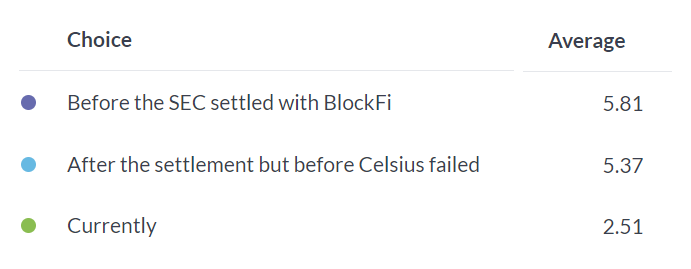
Given the number of respondents, the small decline before and after the SEC settlement was not statistically significant and had a reasonable probability of being due to random chance. If the respondents are to be believed, however, the failure of Celsius has had a disastrous impact on all lenders, not only Celsius.
Choice of lending platformsThe following table details the lending platforms where the survey respondents had money deposited:
| Platform | Before the SEC settlement | After the SEC settlement |
| BlockFi | 26 | 19 |
| Celsius | 24 | 21 |
| Ledn | 24 | 23 |
| Nexo | 13 | 14 |
| Gemini | 10 | 10 |
| Proof-of-stake in any coin | 9 | 10 |
| Crypto.com | 9 | 7 |
| All other | 8 | 9 |
| Binance | 6 | 6 |
| Any DeFi contract | 5 | 8 |
| Coinbase (0.15% USD interest) | 3 | 2 |
| Voyager | 3 | 3 |
| Abra | 1 | 1 |
| Genesis | 1 | 1 |
There were no significant changes in the behavior of survey respondents caused by the SEC's settlement with BlockFi. The only data that approaches significance seems to be that a few people were simply turned away from BlockFi. The SEC's press release putting other platforms "on notice," at least according to respondents, had no impact.
Earning method safety
The table below details respondents' perceptions of the safety of twelve methods of earning interest on crypto deposits. For this question, a rating of 1 indicated that the respondent felt he was certain to lose money, while a rating of 7 indicated that the respondent felt he would never lose money.
| Platform | Rating (1 to 7) |
| Abra | 1.68 |
| Voyager | 2.00 |
| Average DeFi contract | 2.07 |
| Pooled staking | 2.48 |
| Crypto.com | 2.62 |
| Nexo | 3.02 |
| Binance | 3.35 |
| BlockFi | 3.40 |
| Genesis | 3.62 |
| Gemini | 3.71 |
| Coinbase | 4.07 |
| Ledn | 4.29 |
These platforms offer significantly different products. Pooled staking isn't based on lending at all, and Coinbase pays just 0.15% on USDC deposits, which for some reason isn't restricted by the SEC. Nevertheless, it's clear that Voyager's enormous losses to bankrupt firm 3 Arrows Capital and reduced withdrawal limits have shaken faith in their platform. And, despite 20% of respondents stating in a later question that they were moving their assets from centralized to decentralized earning methods, both pooled staking and DeFi were among the methods with the lowest perceived safety.
Ledn has the most trusted brand in the industry according to this survey. Genesis, however, has a public relations problem, because the survey results are illogical. Since Ledn and Gemini both lend most of their assets to Genesis, it makes no sense that adding another company to the lending chain would increase safety. Perhaps Genesis's recent statements about losses surrounding a "large borrower," while honest, turned public opinion against them. Gemini, which lends only to Genesis, made no such statements and is ranked higher in the survey.
Withdrawals from platformsFear is widespread in the lending industry. Many would not be surprised to learn that respondents attempted to withdrawal 45.07% of their assets from the lending market in June 2022. It makes intuitive sense that having half as much available to borrow would lead interest rates to double, although economics is much more complicated than a simple rule of thumb. Nevertheless, rates at the largest brokers have indeed doubled across most coins.
Respondents were not reacting with outright panic; only 16% actually attempted to withdraw all of their assets. A greater number (21%) didn't change their lending habits at all.
Safety of crypto lending vs banksDepositors may be withdrawing their assets from crypto lending platforms because they perceive the risks as far higher than the interest paid. Respondents expect that any given lending platform has a 35.23% chance of default in a given year. By comparison, depositors don't trust banks much either, believing that a traditional bank would have a 9.91% yearly failure rate if governments did not offer insurance.
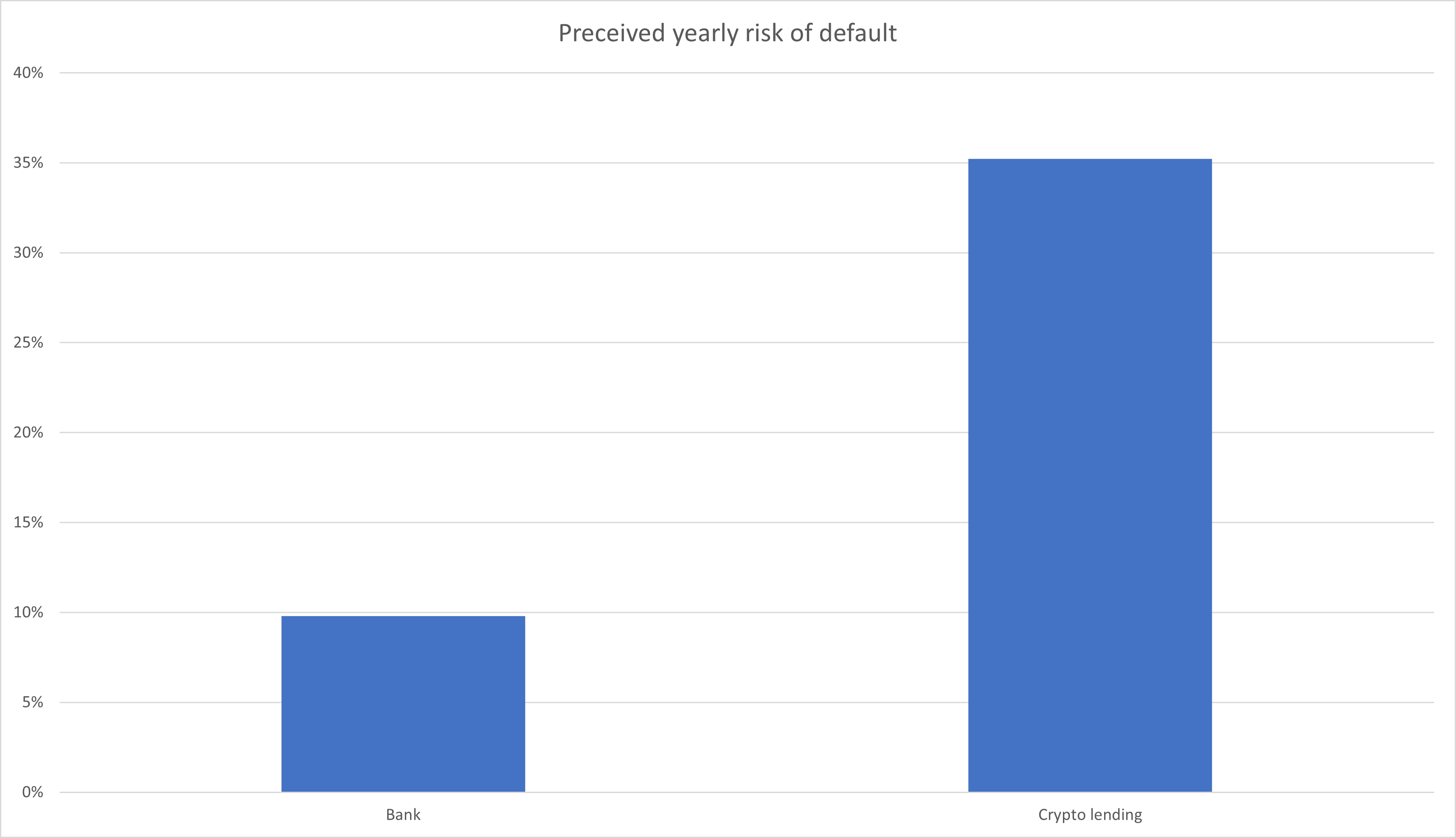
The risk of a bank failure implied here is about once every 11 years per bank, which is far higher than the historical average. In 2021 not a single bank failure occurred in the United States, and even in 2008, only 157 banks failed in the entire country.
SEC impactsAfter asking general questions about the safety of lending platforms, the survey then changed its approach to focus more heavily on attitudes towards the SEC.
First, respondents were asked for their opinions of SEC chairman Gary Gensler. Gensler has been in conflict with other SEC members, such as Hester Pierce, who is frequently outvoted by Gensler and the majority of commissioners who have strict views against cryptocurrencies. A majority of respondents disapprove of Gensler, with his approval rating averaging 3.00 out of 7. Responses were remarkably consistent on this question - no respondent rated Gensler above a score of 5, and only three rated Gensler with a score of 1.
Next, respondents were asked whether the SEC's actions have improved the crypto lending industry. Despite 53.5% of the survey respondents having lost money at Celsius, over 60% of respondents thought that the SEC's actions have made the industry worse, so many Celsius depositors agreed that the SEC's actions actually worsened the situation.
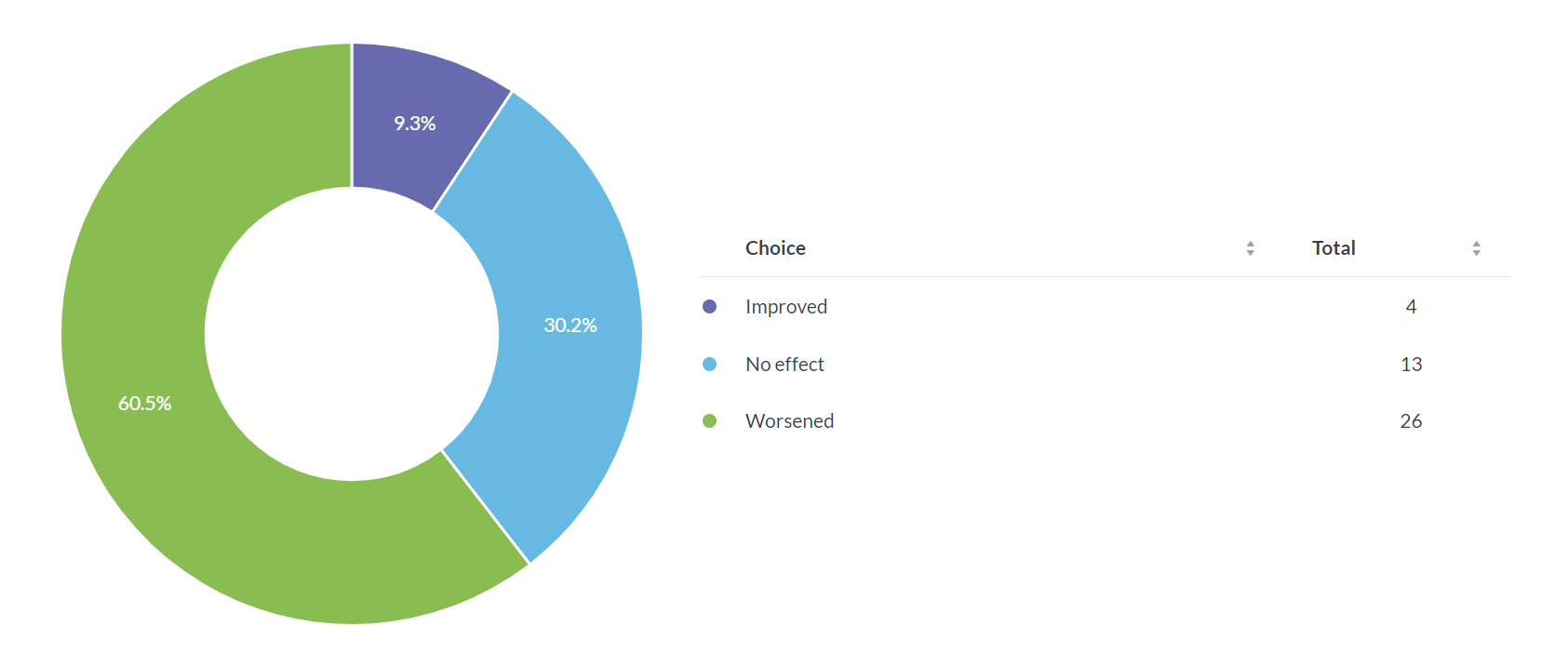
As the SEC targeted BlockFi, not Celsius, and as Celsius was the last lender to accept deposits from US customers, it is perhaps not surprising that those who deposited at Celsius blame the SEC for the lack of alternative options.
Losses on exchanges
As expected, the industry's businesses are plagued by hacks, thefts, mistakes, and insolvencies. The average respondent lost $3,220.50 to exchanges, and 40% of respondents lost at least one dollar.
One respondent lost more than a million dollars, while PROHASHING was the second largest loser with $410,000 time-of-value losses at Cryptsy, Altilly, Graviex, Celsius, and even two deposits that Coinbase still fails to credit.
The question asked respondents for the dollar value at the time of loss, so the actual value of the lost coins that the respondent would still have now may be higher or lower than the reported figures.
Future plansThe survey's final question asked whether respondents planned to make changes in their portfolio's deposit location.
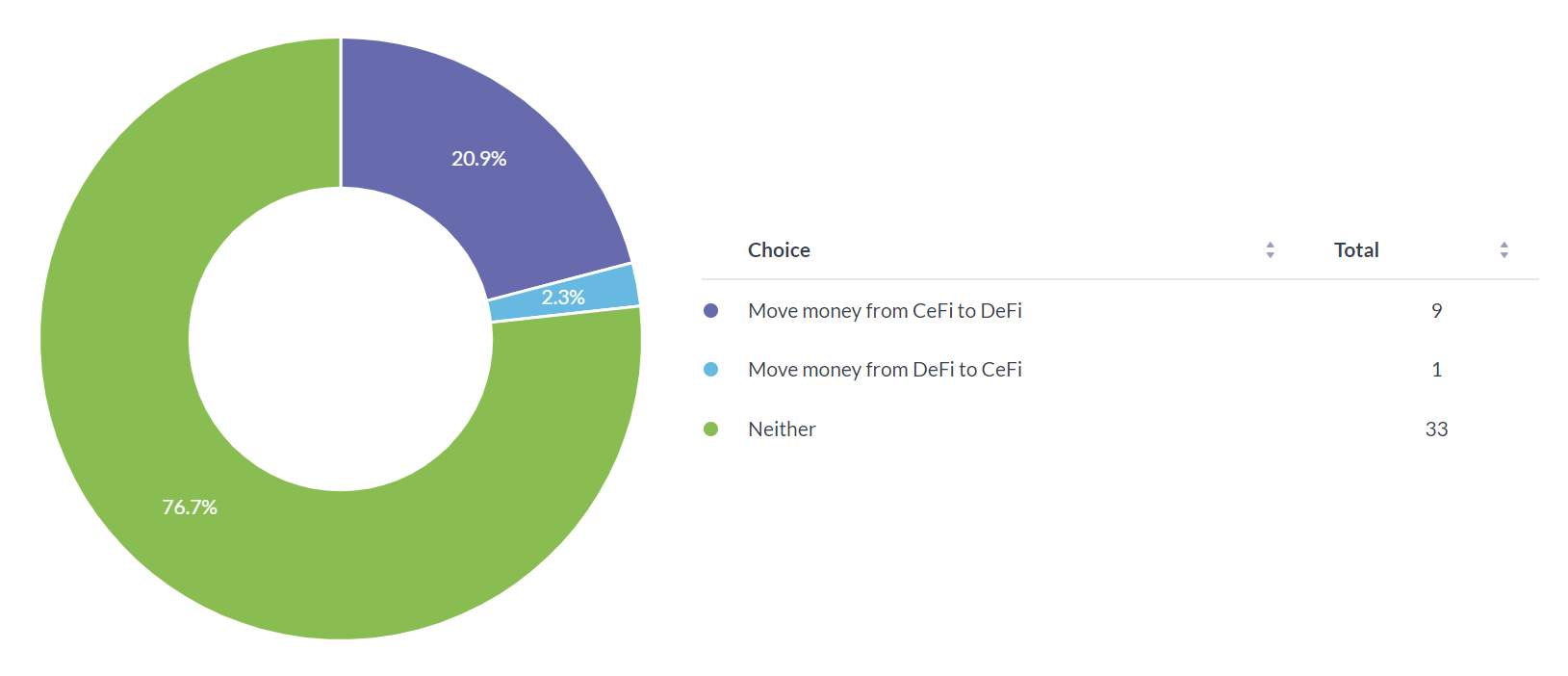
While most respondents were not planning to move money, 1 in 5 were planning to move money away from centralized platforms to DeFi platforms. Given that DeFi platforms have their own problems with bugs and hacks, I plan to try to compute an analysis of whether centralized or decentralized platforms are actually safer in a future post.
ConclusionIn conclusion, my assertion in the previous post that Celsius's failure will critically damage the entire lending industry appears to have been borne out in the survey respondents' views. Confidence in lending platforms cratered after Celsius failed, and many respondents decided to move money to decentralized platforms despite having little faith in those platforms. Around half of respondents' money was removed from the lending market altogether.
The SEC appears to have been ineffective in changing user behavior, with no statistically significant impact on choice or number of used lending platforms after its enforcement action against BlockFi. Respondents disapprove of chairman Gary Gensler, and a majority believe that the SEC made the situation worse, not better. Many respondents apparently ignored the SEC's settlement with BlockFi, trusting BlockFi more than other platforms that were subject to no such action.
Perhaps the results could be best paraphrased by stating that "regulations don't create safe companies; honest people create safe companies." I personally still believe that lending with cryptocurrencies as collateral is safer than lending with a house as collateral; the problem is that we will probably find out that many of the failing companies were hiding the truth or committing outright fraud in their statements about their lending practices. The silence and lack of denials from CEO Alex Mashinsky, now in its 17th day, screams of criminality at Celsius.
Unfortunately, and contrary to random twitter posts, people don't "learn lessons" about what not to do after these dishonest companies fail, because they have no money to deposit. They just lose their homes, are forced to layoff their employees, and are permanently unable to deposit at their honest competitors.
Comments (0)
Archived discussion. New comments and replies are closed.
No archived comments on this article.